
ChainLinkGod Interview: A Chainlinked World 7 Years in the Future
Table of contents (10)
- 1We Proudly Present to You: ChainLinkGod
- 2How Chainlink Works
- 3Chainlink’s Impact on Transforming Global Markets
- 4Chainlink Key Partnerships
- 5Chainlink’s Impact on the Insurance Industry, Healthcare, AI and More
- 6Chainlink’s Importance for Privacy in the Field of Digital Identity
- 7Chainlink’s Responsiveness to User Needs
- 8Predicting the Adoption Rate of Chainlinked dApps
- 9Bonus Question
- 10Get Ready for the Dawn of New Times
Get a glimpse into the visionary spirit of ChainLinkGod in this exclusive interview. Discover the unlimited potential of Chainlink-enabled use cases many years into the future. Expect ideas on the development of Decentralized Oracle Networks (DONs) and their impact on various industries worldwide that are well beyond the horizon of most people.
When it comes to raising awareness and education about Web3, few people have resonated as much on Twitter as ChainLinkGod. As an expert and defender of the crypto space, ChainLinkGod lives up to his name by relentlessly striving to understand and advance the potential of decentralized technologies, most notably Chainlink as the leading Web3 services platform. His simple explanations of complex issues have inspired countless people, from novices to veterans, who strive to understand the complexities and possible use cases of these revolutionary technologies.
In this exclusive interview, we have the privilege of utilizing ChainLinkGod’s expertise as he shares his vision for Chainlink’s use cases in a world 7 years in the future. Join us as we delve into the mind of a visionary and discover how Chainlink will transform entire industries and usher in unprecedented innovation on a global scale.
We Proudly Present to You: ChainLinkGod
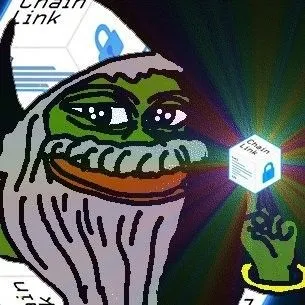
LR: First of all: thanks for your time!
How do you feel when you think about what Chainlink will be like in 7 years?
CLG: Thanks for the opportunity! Crypto moves at a speed that is unlike any other industry, where years of progress can be made in just a short few months or even weeks. So the future of Chainlink in 2030 is intrinsically tied to where crypto/Web3 will be at in its adoption lifecycle at that time. Ideally in seven years, regulatory clarity issues around crypto and blockchain scalability limitations will be solved problems.
Chainlink in its current state is rapidly accelerating towards becoming a full fledged Web3 services platform providing secure access to any resource that onchain applications require. This encapsulates external data (low latency oracles), off-chain compute (Functions), and cross-chain interoperability (CCIP). These Web3 services will only continue to grow in importance. Eventually, I foresee much of what makes up a “smart contract” consisting of mostly offchain logic running in a verifiable manner via oracle networks, with blockchains simply used as the final settlement layer.
By 2030, I would anticipate a significant amount of the assets within the traditional financial system will have been converted into an onchain format, made possible through Chainlink services. Most people likely won’t even realize they’re using Chainlink or blockchains, as all of the technical complexity will be abstracted away into the background. Just as we can’t imagine how we would survive without the internet today, I foresee the same being true about Chainlinked-applications.
How Chainlink Works
LR: What are the key building blocks that make Chainlink work the way it works?
CLG: Currently, Chainlink services are underpinned by the Off-Chain Reporting (OCR) protocol—a novel consensus protocol for oracle networks involving a rotating leader selection algorithm, a round-robin onchain transmission procedure, and a byzantine fault tolerant design. OCR optimizes for resiliency in the presence of faulty nodes, simplicity in architectural design, low transaction fees via offchain aggregation, and low-latency communication between nodes. The latest version of OCR was explored at SmartCon 2022, serving as a generalization of the consensus protocol that can support new oracle services as pluggable modules (OCR 2.0 is being used for CCIP today).
In addition, Chainlink has one of the highest quality node operator sets across the Web3 ecosystem, with an economic model that ensures oracle reports are published onchain even during extreme market volatility and blockchain network congestion. The combination of OCR 2.0 and high-quality nodes allow for the generation of consensus around any data point or computation, resulting in what can be called consensus-as-a-service.
Chainlink’s Impact on Transforming Global Markets
LR: Looking ahead, which industries or sectors do you think will see the biggest transformative impact of Chainlink technology over the next 7 years?
CLG: It’s clear to me that asset tokenization within capital markets represents by far the largest market opportunity for not only Chainlink services, but the crypto ecosystem as a whole. There are trillions of dollars worth of assets in TradFi that can be tokenized onchain (currencies, commodities, securities, etc), presenting immense benefits in terms of increasing transparency, reducing costs, and facilitating financial innovation within the global financial system.
However, institutions need a secure abstraction layer to connect their existing backend infrastructure to blockchains and an interoperability solution to transport assets across the hundreds of different public/private chains. This is what CCIP makes possible, providing the infrastructure necessary to move tokenized assets from simple proof-of-concepts to full in-production products that can reach a global scale.
The end state is a global Internet of Contracts where private/bank chains are interconnected with public/DeFi chains, with value and assets flowing to where they are most useful.
Chainlink Key Partnerships
LR: What partnerships or collaborations do you see as key to realizing Chainlink’s potential across sectors and how could these partnerships accelerate adoption?
CLG: The largest and most timely collaboration I can point to is Chainlink’s recent collaboration with Swift and more than a dozen of the largest financial institutions and market infrastructure providers on using CCIP for blockchain connectivity and interoperability to reduce friction with asset tokenization. The collaboration included the likes of ANZ, BNP Paribas, BNY Mellon, Citi, Clearstream, Euroclear, Lloyds, SIX Digital Exchange (SDX) and The DTCC. The collaboration demonstrated how financial institutions can connect their existing Swift infrastructure to any public/private blockchain using CCIP and engage in cross-chain tokenized asset settlement.
A blockchain interoperability standard (CCIP) becoming widely adopted by the institutions who run the global financial system would represent a major positive shift towards the realization of tokenized assets at scale. Given that the aforementioned participants manage trillions in value flow, with the DTCC in particular processing quadrillions of dollars worth of securities annually, only a small portion of that value being converted into an onchain format would represent at least an 10x increase in the utility and value of our industry.
Chainlink’s Impact on the Insurance Industry, Healthcare, AI and More
LR: Looking beyond financial applications, can you shed some light on how Chainlink services could revolutionize other industries like insurance, healthcare, education or entertainment?
CLG: Any onchain application that wants to provide real tangible value to society will require or benefit from incorporating oracle services into their tech-stack for one reason or another. Whether that be weather data for insurance, identity data for healthcare, GPS location data for global logistics, verifiable RNG for gaming, cryptographic guardrails for AI, and beyond.
The sky’s truly the limit here in terms of the utility that Chainlink-enabled applications can bring to global industries. At the end of the day, it’s the developers leveraging Chainlink services that revolutionize such industries.
Chainlink’s Importance for Privacy in the Field of Digital Identity
LR: How do you think Chainlink can have a positive impact on digital identity developments in terms of data protection and privacy?
CLG: As the Web3 ecosystem continues to scale, the need for digital identity will undoubtedly accelerate, but naturally privacy around personal information will be crucial given the public nature of blockchains. Chainlink’s DECO is a technology that aims to address exactly this, specifically by enabling smart contracts to generate useful outputs based on inputs that take the form of privacy-preserving information from existing web servers.
By leveraging existing data infrastructure, together with DECO’s novel usage of zero-knowledge proofs, privacy-preserving identity systems can be seamlessly bootstrapped into existence much faster than they otherwise would have been able.
Chainlink’s Responsiveness to User Needs
LR: In a rapidly evolving landscape, what steps do you think need to be taken to ensure that Chainlink’s vision remains aligned with the evolving needs of industries and users over the next 7 years?
CLG: The Chainlink ecosystem aims to serve as a credibly neutral platform that provides developers the tooling required to build useful applications. Making it easier for users to configure services to suit their exact needs (e.g., Functions executing user-provided JavaScript code off-chain) and even dApps creating their own services within the Chainlink Network (e.g., Gains Network custom DONs) is how Chainlink will not only scale over time, but provide the greatest amount of flexibility to continue meeting the evolving needs of users within the Chainlink ecosystem.
Predicting the Adoption Rate of Chainlinked dApps
LR: We wonder what percentage of all dApps will use one or more Chainlink services in 7 years. What do you think?
CLG: With aggressive assumptions, nearly 100%. The vast majority of useful dApps require more than just what a single blockchain can offer. And while developers can limit the utility of their applications to avoid oracles, the reality is that they will likely be out-competed by those who embrace using secure oracle infrastructure.
Chainlink network effects are accelerating, where now multiple oracle services can be composed together to create applications more advanced than its individual components. There will always be certain applications that can be built largely in isolation (e.g. simply holding BTC on the Bitcoin network as a SoV), however I generally see these as outliers.
Thinking even more broadly, Chainlink services not only serve purely Web3-native applications, but can also benefit the vast array of existing Web2 applications. Developers can integrate Chainlink services to bring the benefits of self-verification to any market vertical, putting more control into the hands of the users. I’m excited to see what the future brings in this regard.
Bonus Question
LR: As a last question, what is your favorite Chainlink meme?
CLG: It’s honestly difficult to choose just one, but if I had to…

LR: Thank you for taking the time to answer our questions, sir.
Get Ready for the Dawn of New Times
We hope our chat with ChainLinkGod gave you a fascinating glimpse into the future. We find his vision of the world 7 years from now, shaped by Chainlink’s profound influence, both captivating and inspiring.
His perspective on how Decentralized Oracle Networks could transform entire industries and thus daily life offers a compelling display of progress and transformation. With a vision of a more interconnected and decentralized world, we look forward to seeing these opportunities materialize as Chainlink continues to lead towards a more transparent technology landscape.