What Is an Enterprise Blockchain?
Table of contents (7)
- 1Understanding Enterprise Blockchains
- 2Role of Private Chains in Banking
- 3Industry Applications: Private Blockchain in Banking
- 4Chainlink: Bridging Blockchains and Real-World Data
- 5Chainlink’s Impact on Financial Institutions
- 6SWIFT and Chainlink Partnership
- 7Future Prospects of Enterprise Blockchain in Finance
Blockchain technology, first popularized by the advent of Bitcoin, has evolved far beyond its initial design as a public ledger for cryptocurrency transactions. Today, blockchains find utility in various sectors, with enterprise blockchains emerging as a powerful tool tailored specifically for business use.
Enterprise blockchain refers to the use of blockchain technology by companies to enhance business processes, improve transaction transparency and secure the exchange and storage of data. Unlike public blockchains, which are open to anyone, enterprise blockchains often operate under permissioned settings where access and participation are controlled.
Understanding Enterprise Blockchains
Enterprise blockchains are distinct from public blockchains most people are familiar with. They are primarily designed with the data privacy, regulatory and operational needs of businesses in mind.
Privacy is paramount in enterprise settings, where companies require that sensitive information remains accessible only to authorized parties. This is achieved through permissioned networks, where participants have known identities and must be granted access to join. Therefore, networks that are inaccessible and invisible to the public are also called private blockchains.
Scalability is another critical feature. Enterprise blockchains are optimized to handle large volumes of transactions quickly, catering to the needs of big businesses that require efficiency at scale. This is facilitated by the smaller number of attack vectors compared to public chains, since the validators and participants of the network are known and are not exclusively incentivized by cryptoeconomic processes.
Additionally, interoperability, the ability for different blockchain systems to communicate and share information, is a vital component, enabling seamless business operations across various platforms and industries.
Examples of enterprise blockchain platforms include Hyperledger Fabric, developed by the Linux Foundation, which supports a range of business applications from supply chain to financial services. Another example is R3’s Corda, specifically designed for the financial sector, focusing on delivering privacy and scalability while maintaining regulatory compliance.

Role of Private Chains in Banking
Private blockchains play a pivotal role in the banking sector, aligning with the industry’s need for privacy, control and security. These blockchains are permissioned networks where access is restricted to specific, verified participants. This setup is ideal for banks, which handle sensitive information and must adhere to stringent regulatory standards.
Security and Control: Private blockchains give banks full control over their networks, including the selection of participants and their permissions. This control helps in managing risks and enforcing compliance with financial regulations.
Efficiency and Cost Reduction: By utilizing private blockchains, banks can streamline various processes, such as clearing and settlement, loan issuance, and identity verification. This reduces the need for intermediaries, minimizes transaction times and cuts operational costs.
Enhanced Transparency and Traceability: While maintaining privacy, private blockchains also offer traceability of transactions. This feature is crucial for audit processes and fraud prevention, providing a transparent yet secure record that can be verified by authorized parties without revealing sensitive information to outsiders.
Industry Applications: Private Blockchain in Banking
Several banks and financial institutions have publicly revealed their involvement with private blockchains to optimize their operations. Here are a few examples:
J.P. Morgan’s Quorum: Built on top of Ethereum, Quorum is a private blockchain initiative by J.P. Morgan designed specifically for enterprise-grade applications. It comes with enhanced security protocols and privacy features, making it suitable for processing private transactions within a group of known participants. Quorum has been utilized for facilitating inter-bank payments, demonstrating significant reductions in transfer time and costs.
HSBC and R3’s Corda: HSBC has implemented R3’s Corda technology for forex trading operations. Corda has helped HSBC enhance the efficiency of its forex trade settlement process, reducing the costs and time associated with traditional methods. This implementation not only demonstrates the capabilities of private blockchains in handling high-volume, complex trading scenarios but also underscores the potential for widespread adoption in the financial sector.
We.trade: Built on IBM’s blockchain platform using Hyperledger Fabric, We.trade was a trade finance consortium backed by several major European banks. Before it wound down in 2022, it gave companies a secure, standardized platform for managing, tracking and securing transactions, and it remains a useful illustration of how blockchain can facilitate international trade by improving operational efficiency and reducing the risks associated with trade finance.
As banks and financial institutions increasingly adopt private blockchain networks for their operations, integrating real-world data into these systems as well as interoperability between different chains remains a challenge. While private blockchains enhance security and efficiency, their isolated nature can limit their utility in scenarios that require interaction with external information. This is where Chainlink comes into play, providing a basic building block for the further development and application of enterprise blockchains as a future standard.
Chainlink: Bridging Blockchains and Real-World Data
Chainlink is the decentralized computing platform powering the verifiable web. It enables smart contracts on blockchains to securely interact with off-chain APIs of legacy systems like widely used application backends. This connection is vital for the execution of smart contracts based on real-world inputs and conditions that they cannot access by default.
Chainlink’s role is particularly crucial in financial settings where the accuracy and timeliness of data—such as asset prices, interest rates, and foreign exchange rates—are necessary for the autonomous and efficient functioning of smart contracts.
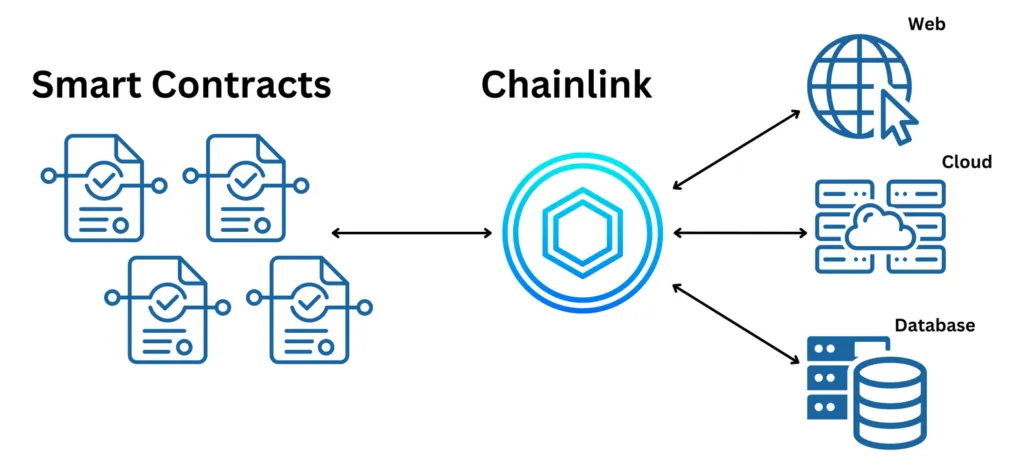
The oracle networks coordinated by Chainlink ensure that the data used in smart contracts is highly reliable and secure. This is partly achieved by decentralizing the data sourcing and delivery process, which protects against single points of failure and provides multiple layers of security checks. For financial institutions, this means that their blockchain applications can operate with an increased level of security compared to existing standards.
Chainlink’s Impact on Financial Institutions
Chainlink’s products have profoundly impacted the traditional finance (TradFi) industry by enabling established institutions to leverage the power of blockchains and smart contracts in their operations. Here are key areas where Chainlink has been instrumental:
Decentralized Oracles: Chainlink serves as a decentralized oracle network that provides reliable data feeds to leading blockchain networks. This enables TradFi companies to use off-chain data, also called real-world data, within decentralized applications (dApps). For instance, stock prices, interest rates, and currency exchange rates can be brought onto the blockchain in real-time, enabling more dynamic and responsive financial products built on top of blockchains.
Secure Data Transportation: Security is a primary concern for financial institutions. Chainlink ensures that data transported into the blockchain environment is secure and resistant to manipulation. This is crucial when decisions regarding large sums of money or sensitive financial transactions are automated and executed by smart contracts.
Smart Contract Connectivity: By facilitating secure connectivity between smart contracts and any legacy backend systems, Chainlink enables financial institutions to automatically execute complex contract terms based on real-time global market data or any arbitrary computation. This connectivity is essential for the adoption of smart contracts in TradFi, where contracts often rely on external validation or manual human interaction.
Expansion into DeFi: Chainlink oracles are pivotal in enabling TradFi institutions to safely explore and integrate with decentralized finance (DeFi) applications. These might include participating in blockchain-based lending services, yield farming, or providing liquidity—all based on secure and reliable data feeds that maintain the integrity of institutional operations.
Facilitating Cross-Chain Interactions: With the rapid expansion of different blockchains, financial institutions need solutions that allow them to operate across these diverse ecosystems. Chainlink facilitates cross-chain communication and transactions, enabling institutions to interact with different blockchains and thereby harness the unique advantages of each. This is achieved through the Cross-Chain Interoperability Protocol (CCIP) developed by Chainlink Labs.
SWIFT and Chainlink Partnership
A practical example of Chainlink’s role in connecting financial institutions to Web3 is its collaboration with SWIFT, the global provider of secure financial messaging services. SWIFT has been working with Chainlink for several years to enable connectivity between traditional financial institutions and public and private blockchain networks.
This partnership allows SWIFT and its partners to send messages triggering cross-chain smart contract operations, expanding its reach into blockchain-enabled financial services. Such initiatives exemplify how Chainlink not only supports but actively enables the TradFi sector to integrate with and utilize the capabilities of decentralized technologies.
By providing these crucial services, Chainlink plays a central role in the transition and transformation of traditional financial institutions towards the use of blockchain technology and exploring the innovative potential of the broader Web3 industry.
Future Prospects of Enterprise Blockchain in Finance
The trajectory for enterprise blockchain within the financial sector is marked by promising developments and the potential for expansive growth. As projects like Chainlink continue to mature and address the initial challenges of integration and operation, you can expect to see an increase in their adoption across more areas of TradFi. The evolution of blockchain will likely spur further innovations in financial products, transaction methods and operational efficiencies.
Emerging trends suggest a move towards greater interoperability between different blockchain networks and traditional financial systems. This can enable a more cohesive and versatile financial ecosystem where assets and data flow seamlessly across boundaries. Additionally, as regulatory frameworks around blockchain technology develop and become more standardized, financial institutions will most likely feel more confident in scaling up their blockchain initiatives.
Moreover, advancements in blockchain technology may lead to more robust and sophisticated DeFi solutions, challenging traditional banking models and offering consumers more autonomy and control over their financial transactions and data.
As these technologies continue to evolve and become more integrated into the fabric of financial services, they will undoubtedly play a pivotal role in shaping the next generation of the global financial system. This evolution, while complex, heralds a new era of transparency, efficiency, and innovation in banking and beyond.