
The Most Effective 11 Steps to Create a Web3 Hiring Plan in a Few Days
Table of contents (12)
- 11. Team and Skill Overview
- 22. Tasks and Areas of Work to Be Delegated
- 33. Refresh Internal Documentation
- 44. Internal Trainee and Onboarding Program
- 55. Time Zone Selection for High Availability
- 66. Candidate Profile
- 77. Company Representation
- 88. Job Advertisements and Recruiters
- 99. Filtering Applications
- 1010. Job Interview Techniques
- 1111. Authenticity and Background Check
- 12Conclusion
In this article, we share strategies on how companies can create an effective Web3 hiring plan to distribute tasks more meaningfully and achieve better results by finding highly talented team members. We refer to the example of Chainlink node operators in some sections because we are at home in the Web3 infrastructure business and know this area best. Nevertheless, this article follows a generalized approach and is useful for both Web3 startups and established companies.
Pretty much every Chainlink node operator is familiar with this problem:
You need to be personally available and responsive 24/7/365 because you are the only one who can realize new deployments or debug and fix any technical issues that arise. In order not to be on call all the time, we want to show you how to find highly talented and trustworthy team members. You can then delegate responsibility and accordingly focus on other important things that go beyond the day-to-day management of Chainlink node infrastructure.
1. Team and Skill Overview
Since Chainlink node operations cover different disciplines, you need specialists in each individual area if you want to be at the forefront of the Web3 oracle business. In order to get an overview of what skills are available in your current team, it is advisable to take a basic inventory as the first step of your hiring plan. It is helpful to create an organizational chart of the company structure that meaningfully divides and clearly delineates the different departments and their responsibilities.
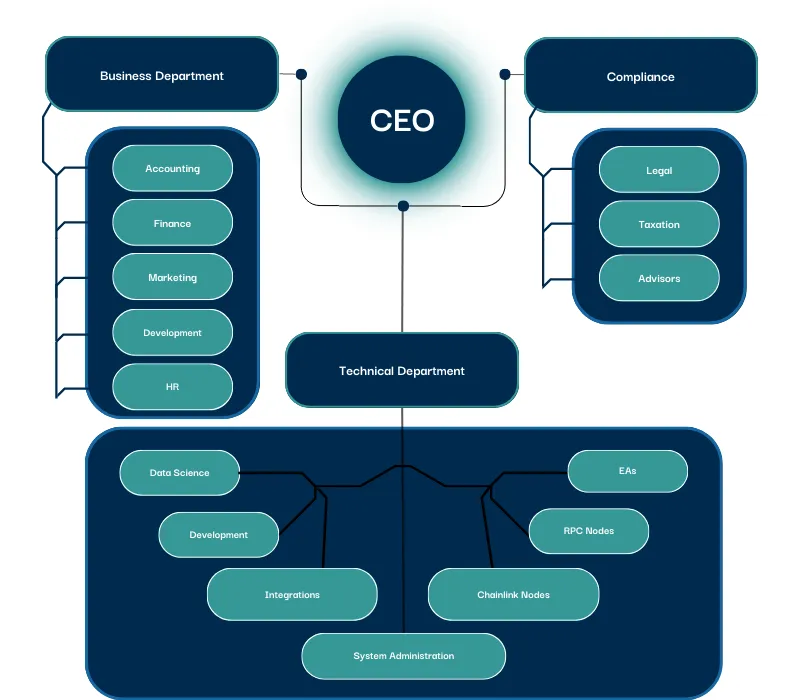
Example organizational structure of a Chainlink node operator
2. Tasks and Areas of Work to Be Delegated
As soon as the organizational chart is available, the next step of the hiring plan is to think about which areas of responsibility and tasks you actually want to hand over. In certain areas, a single responsible person may be sufficient, in others several people may be needed to complete the tasks fully and satisfactorily. Look at where there is room for improvement on your team and make a list of skills and competencies that would bring great benefit. Use this to assess which newly created position would offer the most added value and which you therefore need to hire first.
3. Refresh Internal Documentation
Before you hire, you should prepare your internal documentation accordingly. A lot of potential falls by the wayside when you hire new employees without being well structured yourself. Time is often short because the underlying technology is changing at a rapid pace, so between new integrations and the maintenance of existing infrastructure it can quickly happen that the creation of documentation for certain work steps is neglected. Neglect and procrastination is a serious problem in this respect, as a lack of documentation can mean that only the main person responsible has a full picture of how the infrastructure was deployed, is working and can be maintained accordingly.
The regular creation of documentation thus helps to eliminate the person responsible as a single point of failure and increases the company value immensely, as it greatly facilitates the onboarding of new employees. We highly recommend you to educate yourself on how to write internal documentation to prevent exhausting rework.
4. Internal Trainee and Onboarding Program
Recurring processes such as the onboarding of new team members can be well standardized as part of creating a hiring plan. This requires some initial effort, but saves a lot of time in the long term. Also, if you hire rare and hard-fought experts for your company, an effective onboarding process is a good chance to stand out among other employers. Most important: you sow the seeds for a long fruitful relationship between the company and the employee by being sophisticated from day one on. By clearly defining which specific specialist knowledge and skills new employees should have, content for an internal trainee program can be derived.
Depending on the new position and which department it is subordinate to, you should set up a clearly structured plan for how a new team member can acquire all the basics they need for their day-to-day work. This could include fundamental public resources related to the Web3 economy, but also documentation and guides related to specific internal workflows. In practice, the preparation of such a program has the advantage that you work asynchronously, you only have to check the progress at predetermined sections and you automatically have reliable quality control during the probation period.
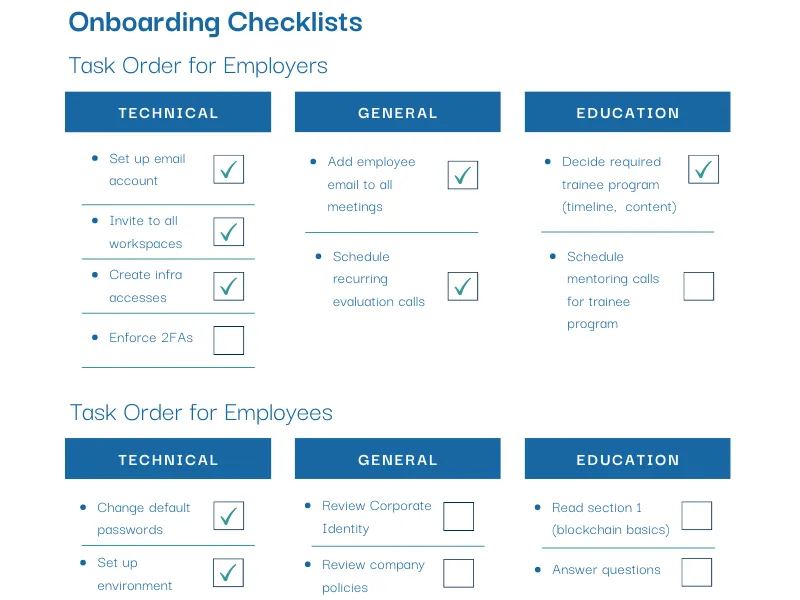
Introducing new team members to the business through standardized processes
5. Time Zone Selection for High Availability
If you hire someone in the technical area, availability for day-to-day work is of course crucial for the hiring plan. Although in the case of Chainlink node operations, most interactions occur during the US daytime, it is still a great benefit to cover as much of the day as possible as an entire operations team. In order to be able to ensure that the infrastructure is monitored by a responsible person at all times, on call schedules should be created so that someone is always available if problems should arise and require intervention. This increases the effectiveness of the team and thus the reputation, so this should definitely be taken into account when selecting the preferred working hours.
6. Candidate Profile
Imagine the perfect candidate, write down the expected skills, experience and characteristics as accurately as possible. Make an effort to be as specific as possible, adding timings to expectations, such as the minimum number of years of hands-on experience someone needs with a particular technology to qualify. Really take your time and work conscientiously, the job advertisement will most likely be the first thing your potential team member will ever see of you and thus have a decisive impact on the impression.
We highly recommend personalizing the job advertisement by choosing the right words. The better you know the personality profile of the imaginary candidate, the better you can address him and get him enthusiastic about your company. It is also advisable to leave as little room for compromises as possible, it is better to write down fewer requirements that are absolutely necessary than to list many nice to haves, this can save you surprises in the induction phase.
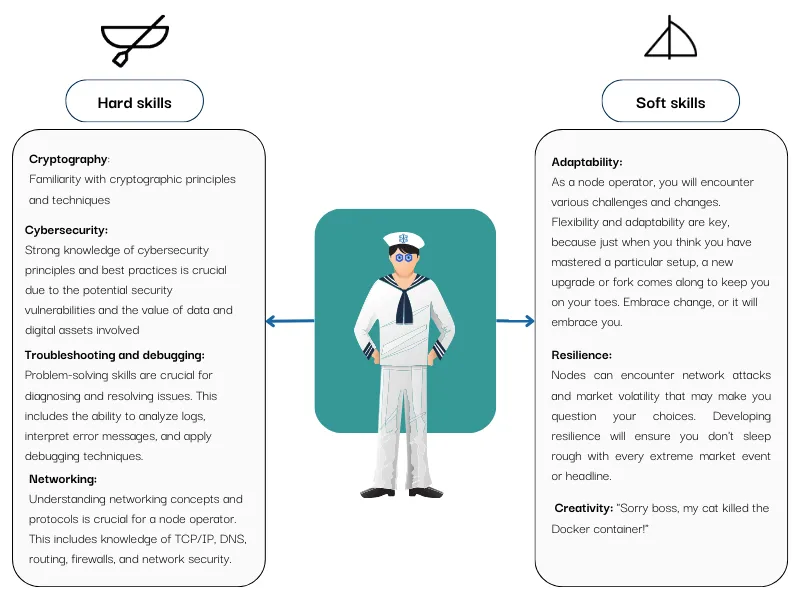
A candidate profile should be thoroughly developed for each position
7. Company Representation
In order to represent your company in the best possible way, you should summarize the most important information about its activities and goals as compactly as possible. Tell them about your core values, vision and the corporate identity so they can see if they share them. Texts that are too long can quickly have a deterrent effect and can easily be skipped. It is in everyone’s interest if you are as transparent as possible here, so avoid making promises that you cannot keep and help ensure that the applicant gets the objectively best possible picture of his future employer. Especially as a Web3 startup, it is worth emphasizing how great the potential is to contribute to fundamental changes in the long term, which will certainly motivate people who share the same interest and values as you to apply.
8. Job Advertisements and Recruiters
When choosing the platform you want to use to publish your job advertisement, the target group is crucial. One of the largest platforms for this is LinkedIn, where you can easily create ads in great detail and use many ready-made features. Of course there are also platforms that have specialized in the Web3 hiring area, such as:
-
Upwork (marketplace to find recruiters and employees)
-
Hy.pe (sourcing worldclass Web3 talents)
-
web3.career (direct contact to Web3 experts)
-
Cryptocurrencyjobs (custom hiring solutions)
It’s a good idea to simply test which provider you like the most, and it generally doesn’t hurt to post your advertisements on different platforms. Due to the large number of applications that may be expected, you can incorporate helpful filters into the job advertisement, for example by asking the applicants in the description to send a personal cover letter and their GitHub page to your hiring email in addition to the application on the platform. Paying for increased reach of your job ads or a specialized recruiter can also pay off and save you a lot of time.
9. Filtering Applications
If you have gotten to the point where the applications are just pouring in, the hiring plan has been successful up to this point. With the selection work, however, a further, decisive phase begins. Stick to your minimum requirements and don’t compromise on applicants not meeting them. Even if you don’t come up with the best-looking candidate yet, be patient rather than making admissions that you may later regret. Create an overview of all candidates who meet the conditions, add their CVs and cover letters and create a ranking based on your assessment.
Introduce communication guidelines with ready-made emails that you can send to your applicants consistently. In the overview you can also document who you have already contacted and what the status of the application is. If you have now made a selection of applicants that you would like to get to know, share your availability with them so that they can schedule a first job interview, there are helpful solutions for this, such as Calendly.
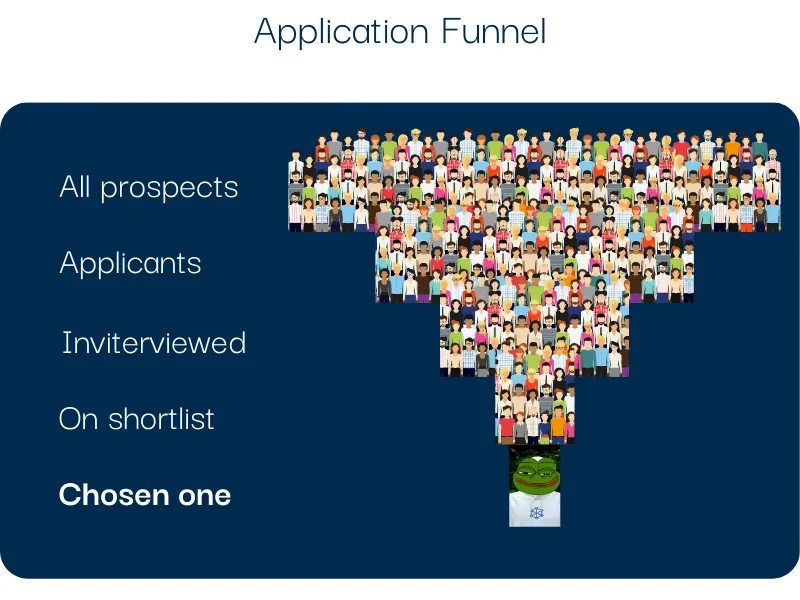
Structured selection processes lead to the ideal candidate
10. Job Interview Techniques
You have probably had job interviews at different companies yourself, and in most cases they are probably very similar: questions are asked about your CV, the company, the industry, and so on. Do not waste your time by having the applicant repeat what you have already read in the CV. A good start to the conversation is important. For most people, a job interview is a stressful situation, so it is advisable to create a relaxed atmosphere with a casual initial conversation. This can be banal small talk, you can briefly introduce yourself and your role in the company and so on.
It is advisable to use the first interview to get to know the person behind the CV, qualifications and experience on paper are one thing, but more important is that the character and attitude of the candidate matches your vision. Here you can let your creativity run free, ask questions that are unexpected and lure your interlocutor out of reserve, so you have the greatest probability of not hearing any ready-made answers. Of course, you can also ask specific questions to get an idea of the candidate’s expertise, but it is anyway necessary to carry out a proper skill assessment in the further course of the application.
Also let the candidate space to ask their questions, which usually gives a lot of information about their interest in your company and their attitude. With highly specialized talented people, it is of great importance to listen carefully to what their needs are. If you respond to these, you have a better chance of winning them over to your team. Not using modern interview techniques is, if at all, only leading to old-fashioned employees.
11. Authenticity and Background Check
Once you have decided on a candidate who meets all your requirements, the contractual conditions must be settled. Unfortunately, the rapid development of Web3 also brings with it many attack vectors and scammers have developed a high level of sophistication. Whether a prospective employee is directly involved in sensitive IT operations or gaining access to confidential company information, you should carefully consider who you are dealing with. A first step at this point of the hiring plan is the collection of personal data and documents, which should be checked for authenticity. This could include:
-
National ID documents (ID card, passport)
-
Up-to-date proof of residence
-
Up-to-date extract from police record
-
Study and course certificates
-
Letters of recommendation of previous employers
Each team is free to decide how these data and documents are to be checked for authenticity. There are various ways to carry out in-depth background checks, but of course it is important to comply with the applicable legislation. Every company should have its own security policies that cover hiring and the associated background checks. If a candidate meets the criteria set out there, they can then be offered an employment contract.
Conclusion
Due to rapidly increasing competition and adoption, hiring in Web3 is a major obstacle for many teams. We hope that this article, in which we have highlighted how to create an effective Web3 hiring plan, will help you find highly talented employees.
If you need help creating your customized hiring plan or are struggling with a specific step, we are happy to share our extensive experience in this area. Feel free to take a look at our Web3 consulting service, for which we have created the following page: