How Is Blockchain Different from Traditional Database Models?
Table of contents (9)
In today’s rapidly evolving digital landscape, the distinction between blockchain technology and traditional database models is increasingly relevant. Both technologies serve as foundational components for managing data across various sectors, but they differ significantly in architecture, control mechanisms, and applications.
Understanding these differences is critical for organizations and individuals as they make decisions about the data management solutions that best meet their needs.
Fundamental Concepts of Blockchain and Traditional Databases
Blockchain Technology
Blockchain is a distributed ledger technology where data is stored in blocks that are linked and secured using cryptographic principles. Each block contains a timestamp, transaction data, and a cryptographic hash of the previous block, creating a chain of blocks. This design ensures that once a block is added to the chain, it cannot be altered without redoing all subsequent blocks, leading to a high degree of immutability.
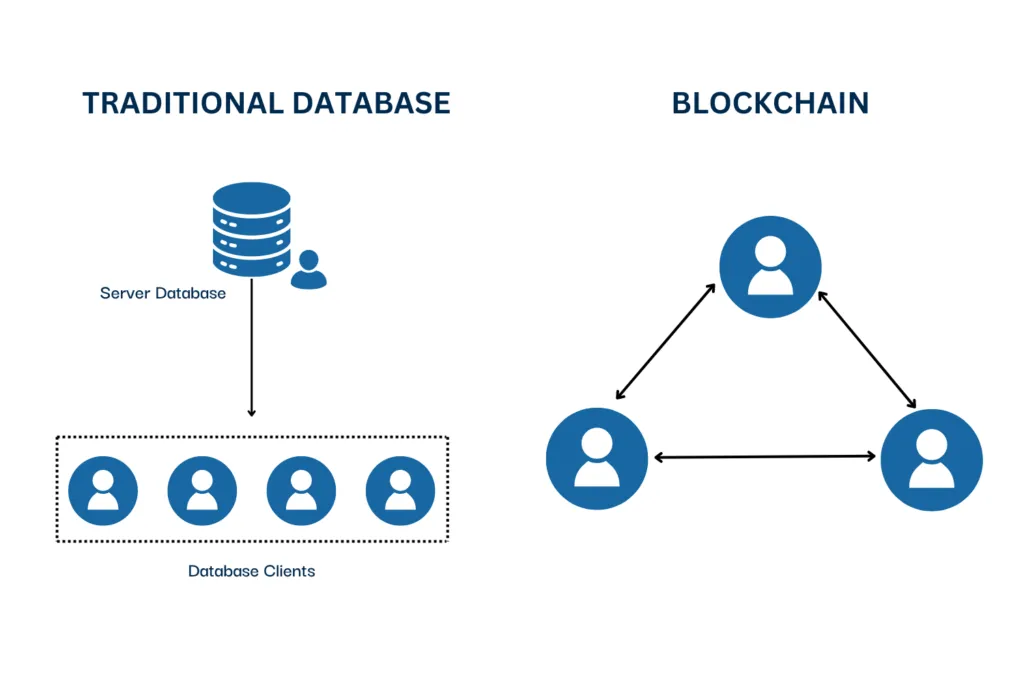
Blockchain operates on a decentralized network, meaning that no single entity has control over the entire database. Instead, data is replicated across multiple nodes in the network, ensuring transparency and resilience to tampering or failure.
Traditional Databases
In contrast, legacy databases use a centralized structure where a single entity or a selected few have control over the entire system. These databases are managed through a client-server network where a central server maintains the data, and multiple clients can access and modify it as permitted by the system administrator. Traditional databases are structured into tables, rows, and columns, allowing for efficient querying and data retrieval processes. They are designed to handle a large volume of transactions and can enforce multiple access levels to secure sensitive data effectively.
Both blockchain and traditional databases offer robust solutions for data management but are tailored for markedly different use cases.
Data Structure Differences
The structure of stored data is a fundamental aspect that distinguishes blockchains from traditional databases. On a blockchain, information is grouped into blocks, each containing a set of transactions, which are then chained together using cryptographic hashes.
This chain forms a secure sequence, ensuring that once data is appended to it, it cannot be altered without adjusting all subsequent blocks by obtaining network consensus. This structure inherently promotes data integrity and auditability.
On the other hand, traditional databases organize data into tables, rows, and columns. This model is highly efficient for querying and manipulating large volumes of data rapidly and flexibly. Administrators can perform complex queries to retrieve or update data across multiple tables through relational operations, which is not inherently possible with blockchain’s linear, append-only structure.
Access and Control
Access and control mechanisms further differentiate blockchain from traditional databases. Blockchain technology employs a decentralized control where no single entity owns the system. Instead, it relies on consensus principles like proof of work (PoW) or proof of stake (PoS), which require network participants to agree on the validity of transactions before they are added to the ledger. This approach not only minimizes the risk of data tampering but also removes the need for a trusted central authority, democratizing data access among its users.
In contrast, traditional databases are centrally controlled by designated administrators who manage access, perform backups, and handle recovery. Access to data can be finely tuned through sophisticated permissions and roles defined by the database management system. While this centralized model allows for efficient and controlled data management, it also creates potential vulnerabilities, as the central point of control could be a target for attacks or failures.
Transparency and Security
Blockchain technology is heralded for its transparency and security features. Every transaction on a blockchain is recorded on a ledger that is simultaneously held by all network nodes. On public blockchains, all transactions since the very first block can be reviewed by anybody making the data transparent. The use of cryptographic hashing further secures the transactions, making them resistant to manipulation and fraud.
A traditional database typically does not offer the same level of transparency as both view and write access are strictly controlled by the central entity managing it. Such databases rely on common identity and access management measures to protect user data integrity and privacy. However, the centralized nature of traditional databases can present a vulnerability, making them potential single points of failure and target for attacks, as reflected in the increasing amount of hacks and data breaches at leading companies.
Use Cases and Applications
The distinct characteristics of blockchain and traditional databases suit different applications. Blockchains can be used where decentralized control, security and transparency are particularly important. For example, cryptocurrencies like Bitcoin use blockchain to maintain a secure and transparent transaction ledger without the need for a centralized authority. Similarly, supply chain management benefits from blockchain to provide a golden record of product journeys from origin to consumer. The tokenization of real-world assets (RWA) and related new financial products have the potential to revolutionize traditional finance and other industries by leveraging decentralized technologies.
As of today, traditional databases are widely used in environments where large volumes of transactions need to be processed quickly and cost-efficiently, such as in banking systems or e-commerce platforms. They are also preferred where complex transactions requiring immediate consistency are the norm, such as airline reservation systems or financial accounting systems. From the perspective of the central entity that manages such databases, the ability to independently change entries and past transactions at any time is an advantage, but it comes at the expense of user trust and security.
Advantages and Disadvantages
Both blockchain and traditional databases have their advantages and disadvantages. Blockchains offer decentralized control, which reduces the risks associated with central single points of failure and makes data tampering more challenging. However, to become increasingly competitive for mainstream adoption, blockchains should continue to improve in terms of scalability and transaction costs.
Traditional databases offer high efficiency, scalability and the ability to process complex queries quickly. Compared to a blockchain, they are now technically less complex and costly to implement. However, the centralization of control leads to serious vulnerabilities in terms of security and data protection.
Future Trends in Blockchain Development
The potential for blockchain technology is vast and expanding. As it matures, you can anticipate significant improvements in scalability and efficiency, addressing many of the current limitations. The development of layer-two solutions and cross-chain communication promises to enhance blockchain’s applicability to a wider range of industries.
Moreover, the combination of blockchains and traditional databases could lead to innovative hybrid models that leverage the best features of both systems. Blockchain technology has already begun to revolutionize sectors like finance, healthcare and supply chain management, where the integrity and accessibility of data are paramount.
The distinctions between blockchain and traditional database models highlight the revolutionary approach blockchain brings to data management and security. With its decentralized nature, immutability, and transparency, blockchains offer a robust alternative to traditional databases for certain use cases, particularly in applications where security and data integrity are crucial.
As blockchain technology continues to evolve and address challenges, it is poised to become an increasingly prevalent foundation for all kinds of applications. The use of blockchain will lead to more secure, transparent and sovereign data management practices across various sectors that impact people’s daily lives.