Boosting Node Infrastructure: Migrating from Cloud to Bare Metal
Table of contents (12)
- 1Making Node Infrastructure Scalable
- 2Results
- 3What to Consider before Migrating Chainlink Node Infrastructure in Production
- 3.1Analysis of Running Node Infrastructure/Services
- 3.2Choosing a Bare Metal Provider
- 3.3Planning Network Architecture
- 3.4Planning Migration of Chainlink Nodes and Related Services
- 4How the Node Infrastructure Migration Is Carried out in a Structured Way
- 4.1Preparation of the Environments
- 4.2Installation and Configuration of Service VMs
- 4.3Migration of (Chainlink) Services
- 5Conclusion
In this article, we explain how LinkRiver’s entire production node infrastructure was migrated from a cloud platform to a bare metal environment in two months, experiencing no performance degradation during the migration and resulting in significant performance gains and cost reductions.
This process is explained to you step by step as a case study to support you if you also want to carry out a node infrastructure migration.
Making Node Infrastructure Scalable
Leveraging cloud services can become very costly for node operators due to I/O traffic and hardware requirements, making constant scaling economically difficult. After another bill with a higher price than the previous month, we have decided to migrate our entire node infrastructure in order to reduce our expenses and thus remain competitive in the long term.
Driven by our CTO and System and Network Administrator, we got straight to work to plan the ambitious project and finally benefit from bare metal servers.
Results
-
Percentage reduction in monthly expenses for our entire infrastructure: 40%
-
More control and sovereignty over our servers and data
-
Increased cybersecurity through internal network communication
-
Improvement from two availability regions in the USA to 2 globally distributed availability regions
-
Latency reduction of the internal network communication, improved node performance
-
Direct contact to our personal account manager and real-time support
We have achieved this with the following clearly structured steps, which we have broken down for you below.
What to Consider before Migrating Chainlink Node Infrastructure in Production
The migration of the production infrastructure is a tricky undertaking, since any downtime of the Chainlink nodes should be avoided at all costs. Accordingly, the precise planning and preparation of all steps for the whole process is of great importance.
Analysis of Running Node Infrastructure/Services
First, we created a comprehensive overview of our entire infrastructure and its components. This was particularly important in order to determine which resources the services require and thus to define the specifications of the new hardware.
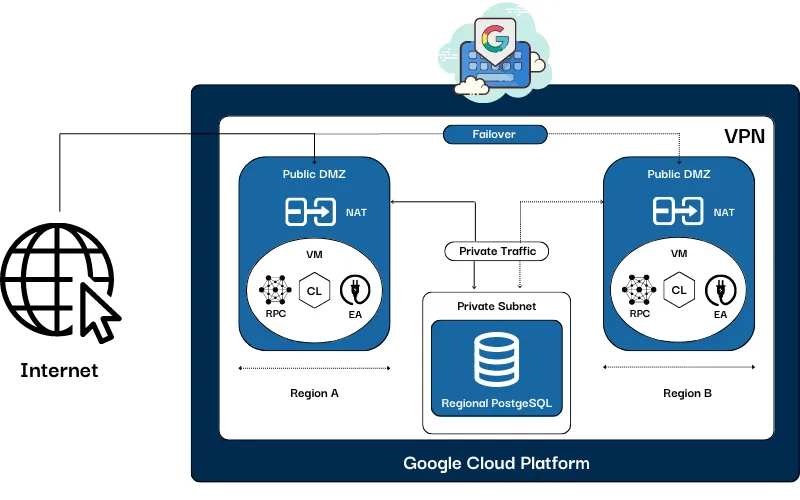
General overview of our GCP architecture before the migration
Choosing a Bare Metal Provider
The next question that came up was whether we would buy our own hardware or use a managed bare metal solution. We chose the second option because of the ease of scaling the infrastructure, the ability to deploy servers in different global regions from the ground up, and the less administrative overhead of maintaining the hardware. We then looked at various bare metal providers and compared their prices and availability information, as well as support offers.
Planning Network Architecture
In order to develop the future network architecture, we first created a network topology. The entire network was divided into subnets and the respective components such as firewalls, routers and NAT gateways were selected.
Planning Migration of Chainlink Nodes and Related Services
For us as a Chainlink node operator, the secure migration of the individual Chainlink services, which are the heart of our infrastructure, was of crucial importance, as everything had to take place in full production mode. We have created an overview of the necessary steps and carefully considered the order in which services should be migrated.
How the Node Infrastructure Migration Is Carried out in a Structured Way
Once the planning phase has been completed, the execution began. It has been crucial to carry out each step carefully in order to avoid any Chainlink node downtime.
Preparation of the Environments
To prepare the environments for our project, we began by initializing High Availability (HA) and failover mechanisms on the bare metal hosts to ensure continuous operation and minimal downtime. This process involved setting up automated Virtual Machine (VM) failover, which allowed for the seamless transfer of workload to standby servers in the event of a primary server failure.
Additionally, we configured disk RAID systems to provide data redundancy and improve fault tolerance, further enhancing the overall resilience of the environment.
To strengthen the network infrastructure, we implemented a variety of network components. This included configuring routers and firewalls, taking into consideration factors such as subnet allocation, routing policies, and the implementation of Demilitarized Zones (DMZ) for increased security. Network Address Translation (NAT) was employed to enable the simultaneous use of a single public IP address by multiple VMs, reducing the demand for public IP addresses and improving network efficiency.
We also set up a VPN server to provide secure remote access for employees and administrators, protecting sensitive data from potential threats. A domain controller was established to centralize identity and policy management, streamlining user authentication and access control.
The Domain Name System (DNS) was configured with a dedicated name server, improving the resolution of domain names to IP addresses and enhancing network performance. The Dynamic Host Configuration Protocol (DHCP) was utilized for the dynamic distribution of IP addresses, ensuring efficient network operation and reducing the risk of IP address conflicts.
Following the implementation of these components, we conducted comprehensive connectivity and security tests to ensure the environment was both robust and secure, as well as to identify and address any potential vulnerabilities.
Installation and Configuration of Service VMs
Next, we focused on the installation and configuration of service VMs, which play a crucial role in running various applications and services within the network. This process involved careful resource allocation to optimize performance, as well as Linux kernel optimization to enhance the efficiency of the underlying operating system. The VMs were then joined to the domain, enabling seamless integration with the domain controller and central management.
To streamline the administration process and enable efficient operation, we deployed Ansible as Infrastructure-as-Code solution for the central management of the VMs. Ansible’s automation capabilities allowed for rapid deployment, configuration, and management of the service VMs, reducing manual intervention and minimizing the potential for human error. With this robust and secure environment in place, the foundation was laid for a high-performance, reliable, and future-proof network infrastructure.
Migration of (Chainlink) Services
In order to initialize the Chainlink nodes in a new environment, their PostgreSQL databases must be migrated. Accordingly, we created backups of each node database and configured the new servers. The backups created have then been restored on the new PostgreSQL servers. The corresponding servers were set up for the Chainlink nodes and External Adapters and their configurations were simply copied.
We deployed most of the RPC nodes completely from scratch in the new environment since most of the clients support snapshot syncing by default. Once all services were deployed in the new environment, the nodes could be started individually while their performance was closely monitored.
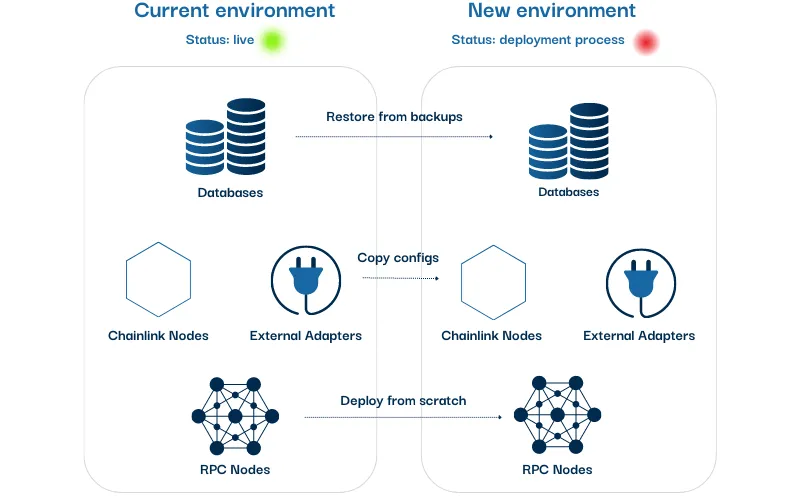
Migration process of node infrastructure in production mode
Conclusion
This infrastructure migration gave us the advantage that we can set up new Chainlink nodes at any time at the push of a button with little or no additional cost. Thus, LinkRiver is technically and economically perfectly prepared for the further, rapidly advancing scaling of the Chainlink network.
The thought of migrating the entire existing node infrastructure can seem daunting at first. It is all the more important to put this plan into action as early as possible, as it becomes more and more difficult and risky with increasing growth. Because we have already taken this step, we now benefit from significantly higher performance at lower costs, which has a positive effect on our profit and reputation.
There are no longer any unpleasant surprises in terms of cloud service bills following new Chainlink integrations. The results were worth the planning and implementation effort, and the migration left us with node infrastructure we can scale predictably as the Chainlink network grows.