The Indispensable Guardians of the Web3 Economy: Chainlink Node Operators

By LinkRiver · · 15 min read

Share
Table of contents (12)
  1. 1Chainlink Nodes Are the Foundation of the Web3 Revolution
  2. 1.1Chainlink Node Operations Are Incomparable to Other Web3 Infrastructure Ventures
  3. 1.2Web3 Adoption Is Surging Thanks to Chainlink
  4. 1.3Network Security and Performance Grows with the Increasing Specialization of Its Participants
  5. 2Development of a Chainlink Node in Time Lapse: LinkRiver Two Years Ago vs LinkRiver Today
  6. 2.1From Moonlighting to Building an International Team of Dedicated Specialists
  7. 2.2The Heart of Our Node Operation: the Infrastructure
  8. 2.3The Company Matures and Implements Policies
  9. 2.4Always One Step Ahead of Regulation
  10. 2.5The Result of the Work Is Reflected in Chainlink Node Jobs
  11. 3It’s Happening - Let’s Continue to Make History Together
  12. 3.1Together We Can Get a Larger Number of Ducks in a Row

Chainlink is the unchallenged Web3 services platform whose infrastructure is decentralized and secured by its industry-leading Chainlink node operators. Chainlink’s revolutionary Data Feeds enabled the Decentralized Finance (DeFi) economy to thrive, registering approximately $250B in Total Locked Value (TVL) at its peak in 2022, ushering in a new era of alternatives to the traditional financial system.

This ongoing boom is due in large part to Chainlink node operators, who, as underlying price oracles that consistently transmit highly accurate data, have enabled the secure development of numerous revolutionary decentralized applications (dApps) used by millions of people.

The Web3 economy is subject to rapid change at all times and therefore demands incomparable adaptivity from its participants. Running Chainlink nodes is the supreme discipline of the Web3 infrastructure business and thus a demanding challenge that requires extensive expertise in various areas if you want to deliver top performance.

In this article, we would like to share what we have been working on over the past two years to become a top-tier Chainlink node operator and how we aim to support other node operators in taking similar steps. We remain highly motivated to make a significant and sustainable contribution to the development of a more decentralized world, which is why we invite Chainlink node operators to join forces even more closely to underpin how the Chainlink network has the greatest significance in terms of Web3 expansion.

In a few years, the currently existing Chainlink node operators will be regarded as absolute pioneers who have made the Web3 revolution possible as indispensable infrastructure foundation. Hopefully as many as possible from the current cohort will then still be on board, which requires continuous further development in step with the pace of development of the Web3 economy.
It is a huge opportunity to actively contribute at such an early stage to shaping and maintaining the Chainlink network, which has the greatest impact on the adoption of blockchains and smart contracts as new technological standards for real-world applications.

These decentralized technologies are the most promising prerequisites for creating a global system that aims to give back to people what has been lost through the previous development of a digitally centralized world — ownership and security of personal data, freedom of expression and finally sovereignty. These vital aspects reinforce our commitment to Chainlink and all the challenges that arise every day from working as a node operator.

Chainlink Node Operator

Blockchains and dApps running on them require Chainlink nodes to access real-world data and more

The day-to-day work of Chainlink node operators is demanding and varied as it involves sophisticated challenges in the field of cutting-edge technology while also requiring careful consideration of other important tasks in non-technical business areas. Due to the daily routines that have to be worked through and unpredictable events that occur regularly, it is not uncommon for a Chainlink node operator to dig further and further down the rabbit hole on a technical level, which can quickly lead to losing sight of the big picture.

Existing Chainlink node operators are doing an incomparably good job, as the Chainlink network has consistently performed reliably since its launch, making it an absolutely exceptional example in the Web3 economy. The expansion of the Chainlink network and the associated newly supported chains and services result in entrepreneurial challenges in addition to their technical integration.

So that we as node operators can all achieve top performance together and keep driving the Chainlink network forward, we want to share our insights on how we can stay one step ahead of the increasing demands and thus prevent performance stagnation, which may remain inconsequential for a while, but will inevitably result in replacement sooner or later in the rapidly evolving Web3 space.

Within the last two years, the Web3 economy, the Chainlink ecosystem and ultimately we as a Chainlink node operator have undergone an enormous change. A rapidly increasing number of institutions and enterprises announced their cooperation with Chainlink. SWIFT, the interbank messaging system, is working on a proof of concept for the Cross-Chain Interoperability Protocol (CCIP) with Chainlink, which will enable SWIFT messages to instruct on-chain token transfers, helping the interbank network to be able to communicate across blockchain environments.

In October 2022, SWIFT officially announced the collaboration of 14 central and commercial banks, including Banque de France, Deutsche Bundesbank, HSBC, Intesa Sanpaolo, NatWest, SMBC, Standard Chartered, UBS and Wells Fargo that joined a test environment to accelerate the development’s path to full scale deployment.

This was followed in June 2023 by the announcement that the community of participants had grown to include over a dozen major financial institutions and FMIs, including well-known players such as Australia and New Zealand Banking Group Limited (ANZ), BNP Paribas, BNY Mellon, Citi, Clearstream, Euroclear, Lloyds Banking Group, SIX Digital Exchange (SDX) and The Depository Trust & Clearing Corporation (DTCC).

Sergey Nazarov’s comment on the last announcement underlines the importance of the current developments and the associated upcoming responsibility of the Chainlink network and its node operators:

If even a small percentage of the quadrillions flowing through the existing market infrastructure moves onto blockchains, the Web3 economy would experience a multiples increase in the value it secures. Chainlink CCIP is not just a gateway for capital markets to Web3; it’s the key to global, on-chain liquidity.

Sergey Nazarov, Co-founder Chainlink

The crypto-economic guarantees, which will be required for adoptions of this scope in the future, were initiated with the successful launch of Chainlink Staking at the end of 2022 and kicked off the era of Chainlink Economics 2.0 with the introduction of additional key initiatives.

It was clear to us that the transition to Chainlink Economics 2.0 implied a mandatory upgrade to LinkRiver 2.0 in order to meet the increasing performance requirements and continue to work as ambitiously as on day one. We dedicated all of our focus and resources solely to Chainlink as we felt other activities would only distract us from optimally positioning ourselves for the upcoming scaling of the network. This focus has helped us realize how many work areas can be constantly optimized purely in relation to Chainlink node operations and can therefore run sub-optimally if not given the necessary attention.

Network Security and Performance Grows with the Increasing Specialization of Its Participants

We therefore believe that the rapid adoption of Chainlink will require node operators to focus on optimizing all relevant workflows and processes in order to keep up with ongoing development and increasing competition in the long term. Due to the collaboration of the Chainlink team and the node operators, all those involved and in particular the network ultimately benefit from the efficiency of the individual parties, which is why teamwork and a proportional increase in performance are extremely important.

Since it has been our vision from the beginning to contribute to further decentralization and thus increasing the security and performance of the Chainlink network, we want to share our knowledge with other node operators and improve together through even closer cooperation and regular exchange. The more sovereign each individual node is, the stronger the entire network becomes. This community spirit is one of our major advantages over the centralized monopolies that Web2 has spawned.

A proper introduction is a helpful step in cementing a relationship. To understand what has changed for us since our onboarding as a Chainlink node operator, let’s look at several factors that are compared below.

From Moonlighting to Building an International Team of Dedicated Specialists

We started out as a founding trio, each of us had a full-time job and we all lived in the same time zone, so LinkRiver started out as a highly ambitious sleep-deprived project. We were able to cover the essential skills to deploy and maintain Chainlink nodes and to lay the necessary structural business foundations. Accordingly, everyone had many different areas of responsibility and had to deal creatively with the solution of new problems every day.

Today, about two years later, our core team consists of nine people who work full-time for LinkRiver. In addition, we work with freelancers and service providers who support us in various projects.

Overall, our team now covers five different time zones around the world, which ensures 24/7 availability. We have set up OnCall schedules that enable permanent monitoring of the systems and immediate intervention in case of technical problems or other critical situations.

Operating Chainlink nodes requires extensive expertise in different areas

The organization is clearly structured by different departments, each team has its own area of responsibility and can fully focus on this. Our System and Network Administrator works closely with the DevOps Engineers, who are responsible for managing the Chainlink nodes and other related services.

The dedicated Data Scientist develops and maintains analysis tools that are tailored to our operations and provide us with helpful insights to continuously optimize them. Our Full Stack Developer builds and implements solutions that we want to offer as helpful services for Chainlink node operators in the near future. The technical department is supervised by the CTO so that an optimal use of resources and efficiency is ensured at all times.

In the area of business administration and compliance, the Managing Director coordinates the relevant processes, communicates with suppliers and business partners and takes care of the management of the company. His close cooperation with the CFO, who oversees treasury management, ensures that the company’s financial resources are used optimally. The Human Resources and Project Manager is responsible for maintaining an open company culture and communication across teams while overseeing ongoing projects.

This separation of duties ensures that the technical department can fully focus on the most relevant tasks without being confronted with non-technical issues, which we believe is of great importance for the node performance. This, in turn, allows the business department to budget wisely and implement strategies to hedge against adverse market conditions while having blind faith in the operability of all systems.

Adhering to the respective areas of responsibility leads to the optimal development of each individual and to efficient, highly communicative work within the team and across departments. The daily work processes are facilitated by modern project management frameworks, which are regularly adapted.

Since hiring in Web3 and the associated challenges must be well thought out and we have gained a lot of experience in it, we have written a complete blog post about it, which you can read here.

The Heart of Our Node Operation: the Infrastructure

Initially, our Chainlink nodes ran exclusively in the cloud, more precisely on the Google Cloud Platform, with an uncomplicated architecture and a minimum of automation. This was the simplest solution at first and worked well, but we quickly diagnosed some disadvantages. While using managed services is very convenient, it also means limited customization options and paying a corresponding premium for the work saved. In general, we did not find the price-performance ratio optimal for maintaining Chainlink and RPC nodes, which of course is also due to their high input/output requirements.

With the scaling of the Chainlink network and thus our growing infrastructure requirements in mind, we decided to migrate to a bare metal environment. Since all of this took place in production, it meant a considerable amount of planning and implementation work, which is why we have described the process in a step-by-step case study.

We now have a much more powerful infrastructure spread across two continents and three different availability zones, and by adopting a sophisticated Infrastructure-as-Code solution, we are able to carry out recurring tasks such as performing updates or setting up new nodes and services fully automatically in the shortest possible time at low additional costs while complying with the highest security standards.

The Company Matures and Implements Policies

Since we were a small team at the beginning and everyone had to manage many areas at the same time, we simply did a lot of things according to our instincts and to the best of our conscience. So far everything has worked well, but there have been misunderstandings from time to time due to a lack of documentation and communication. Especially in the complex Chainlink node environments with different services and configurations, it can have fatal consequences if a team member makes changes without thoroughly documenting them and informing the rest of the team.

In order to prevent such scenarios, we have developed clear company policies and continuously expanded them. An elementary part is the regular writing and maintenance of the documentation, which has become an indispensable routine for all team members, especially in the technical department. Through the joint development of guidelines, existing team members quickly internalized what needs to be considered when creating documentation, and new employees can easily read which standard is used in our company during their onboarding phase.

The same applies to internal and external communication, in the early days, the motto for external communication was mainly “whoever is available answers”. In order to do justice to the increasing complexity and importance of our actions, we have developed a communication policy that clearly regulates how to coordinate within the team and who communicates with external parties and in what form.

From the very beginning, cybersecurity has played a major role for us. Since the founding team is very sensitive to this topic, the introduction of a corresponding policy to ensure security standards as the company continues to grow was high on the list of priorities. Since this is an area that is constantly evolving and becoming more relevant as interconnectivity increases and attackers become more sophisticated, the guidelines also include the obligation to attend regular training courses and are constantly being adapted and expanded.

Always One Step Ahead of Regulation

Legal compliance with the existing relevant legislation is of course only possible to the extent that it exists at all. Nonetheless, due to the nature of our business, we have taken this area very seriously from the start and, after thorough research, have aligned the planning of the company structure accordingly.

A lot has happened within the last two years, so we have prioritized the topicality of our information on the regulation of the crypto sector by being in close contact with specialized lawyers and responsible regulators. Our current resources allow us to pay even greater attention to the compliant expansion of our company in order to be able to act proactively and plan for the long term at all times.

Two years ago, we had a few testnet nodes running, serving legacy Direct Request jobs for users participating in hackathons or working on academic proof of concepts. After winning the first Oracle Olympics and the subsequent onboarding to the officially coordinated Chainlink network, we started participating in Decentralized Oracle Networks (DONs) providing Data Feeds on Ethereum and Polygon.

We were fully committed to Chainlink and focused all our resources on being prepared for proportional growth. We are happy and grateful that this has paid off, as of now we participate in DONs on 13 networks and help secure various Chainlink services.

LinkRiver achieved an increasing number of network and job integrations through continuous performance improvements

It’s Happening - Let’s Continue to Make History Together

Powered by Chainlink node operators, the Chainlink network enabled smart contracts to access real-world data for the first time in history in 2019, greatly expanding the use of blockchain technology and enabling innovations that soon became indispensable. A historical analogy can be found in the not too distant past, namely in the 1990s, when the use cases of computers skyrocketed through connection to the world wide web and within the following 30 years produced the most influential innovations of the modern age. Think of a smart contract enabled blockchain without a Chainlink integration like a computer without internet access, which one can personally use to perform calculations and run simple offline programs.

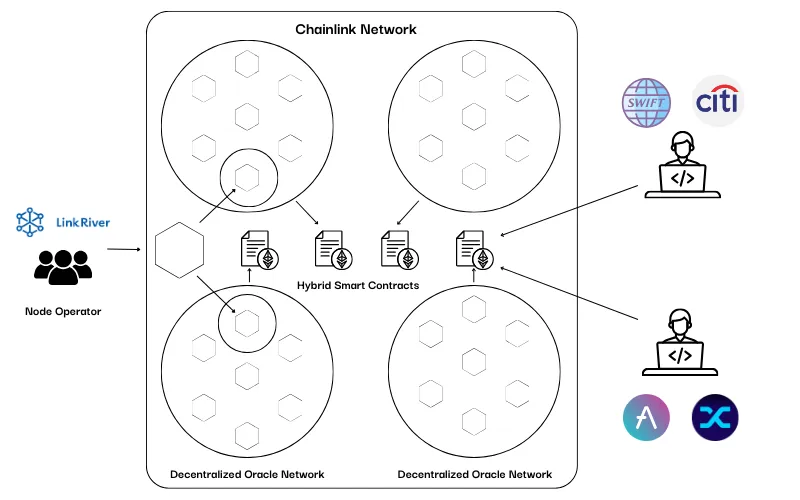
Chainlink as an oracle not only enables individual blockchains to exchange data with the world wide web and all of its APIs, Chainlink DONs can also perform off-chain computation and recurring DevOps tasks on behalf of smart contracts and ultimately allow blockchains to communicate with one another - all based on cryptographic truth, decentralized and secured by Chainlink node operators.

The reach and impact of the possible applications resulting from the interconnectivity of blockchain based hybrid smart contracts and common technologies such as conventional databases, cloud platforms and application backends is difficult to project. The corresponding potential transaction value that the Chainlink network can secure in the future through the entry of established institutions and the associated exploitation of high-value markets is in the realm of quadrillions. The resulting opportunities for positive change in the world are correspondingly large and difficult to imagine.

Play

Together We Can Get a Larger Number of Ducks in a Row

What we have experienced in the last few years was the absolute beginning, the laying of the foundation for a new digital, decentralized revolution. It is safe to assume that the pace of development and change will only increase from now on, as we have reached a historic inflection point.

In our opinion, meeting this responsibility as one of the key infrastructure providers involved will not be any less demanding and competition in this area will certainly increase rapidly. Therefore we decided to initiate the Node Hub and invited Chainlink node operators and Chainlink team members to participate. Through regular meetings and exchange, we want to prepare as well as possible for the challenges ahead and establish ourselves in this area in the long term, which represents a historically unique opportunity. In addition to regular blog posts, we will host calls, publish helpful content via our social channels and organize events that can be designed collaboratively.

Let us give our responsibility as Chainlink node operators the necessary attention and, with the highest possible focus, contribute our part to the movement towards a more decentralized, transparent world powered by cryptographic truth.