Future of Crypto in the Next 5 Years: What to Expect
Table of contents (12)
- 1Technological Innovations in Crypto
- 1.1Proof-of-Stake and Layer 2 Solutions
- 1.2Chainlink Cross-Chain Interoperability and the Financial System
- 1.3Chainlink Empowering Artificial Intelligence, Internet of Things and Economy of Things
- 2Crypto Market Predictions
- 2.1Bitcoin’s Trajectory
- 2.2Overall Market Dynamics
- 2.3Regulatory Landscape
- 3Impact of Web3 Innovation: Shaping Crypto’s Future
- 3.1DeFi: Financial Inclusion Unleashed
- 3.2NFTs and Real-World Assets: Ownership Revolutionized
- 3.3Mainstream Blockchain Adoption: Transforming Critical Societal Processes
In the dynamic cryptocurrency space, the last two years have been a rollercoaster ride of ups and downs that have simultaneously unsettled and fascinated investors, enterprises and governments. The crypto market witnessed significant price fluctuations, showcasing its inherent volatility. Despite the challenges, the Web3 economy displayed remarkable resilience and adaptability, underscoring its potential to revolutionize the financial landscape. This creates a positive outlook for the future of crypto in the next 5 years.
Industry leaders agree on a future in which blockchain technology and cryptocurrencies seamlessly integrate into everyday life — without the average consumer even noticing. Above all, Chainlink has positioned itself as decentralized computing platform to revolutionize major industries and pave the way for a transparent interconnected future.
In the second half of 2022, which included the FTX collapse, the prices of cryptocurrencies such as Bitcoin and Ethereum fell well below their all-time highs. This period of uncertainty kept digital assets in a state of limbo, with market sentiments swinging wildly due to macroeconomic and geopolitical circumstances.
However, despite all the uncertainties, a sense of optimism emerged in the crypto market as 2023 progressed. Major cryptocurrencies, including BTC (Bitcoin), ETH (Ethereum) and LINK (Chainlink), began to regain momentum, supported by a less drastic macroeconomic environment. These trends sparked hope among investors and point to a positive future for the crypto landscape.
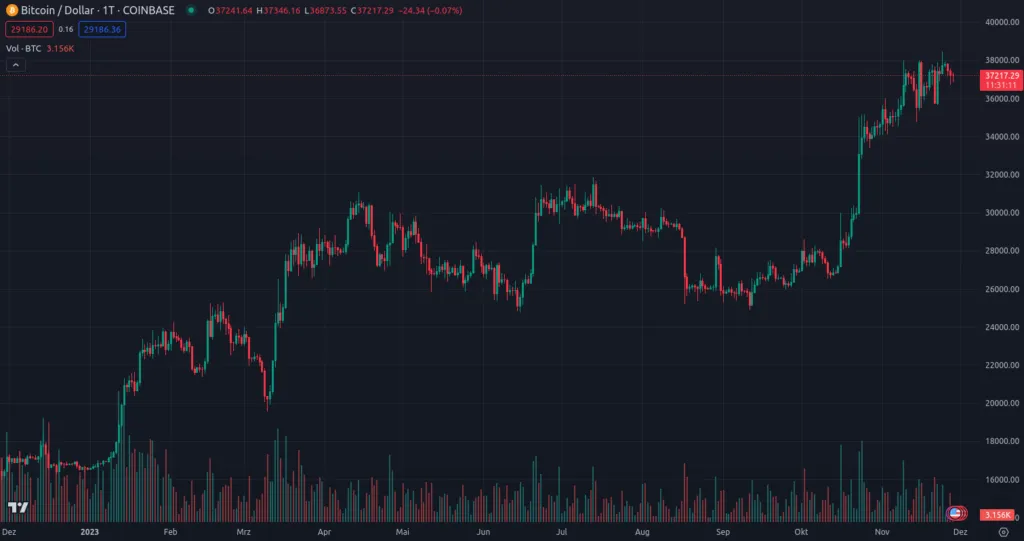
Yearly BTC/USD chart. Source: tradingview.com
Technological Innovations in Crypto
The cryptocurrency landscape is witnessing significant technological advancements that are reshaping its future. One of the key areas of innovation is the underlying blockchain technology, which continues to develop rapidly. Blockchain networks are being used in a growing number of sectors due to their increased performance capabilities, including finance, global trade and insurance. While blockchains serve as the final settlement layer to store the state of a distributed ledger, smart contracts and oracles enable the development of applications that go far beyond sending and storing cryptocurrencies.
Proof-of-Stake and Layer 2 Solutions
In 2023, blockchain technology continued to see significant advancements. Proof-of-Stake (PoS) based blockchains have continued to gain importance due to their higher hardware and energy efficiency compared to traditional Proof-of-Work (PoW) systems.
In addition, layer 2 (L2) solutions such as Arbitrum, Optimism and Base gained further popularity. These address the scalability issues of blockchains by enabling faster and cheaper transactions outside of the main blockchain while still leveraging its security benefits.
Chainlink Cross-Chain Interoperability and the Financial System
Swift, in partnership with leading financial institutions, successfully tested Chainlink’s Cross-Chain Interoperability Protocol (CCIP) to leverage secure money transfer across blockchains and facilitate the tokenization of real-world assets (RWAs). By securely connecting public, private and bank chains, CCIP provides the only reliable, scalable and interoperable solution for the global movement of cryptocurrencies and RWAs. This breakthrough not only revolutionizes asset management, but also eliminates operational and technical challenges and reduces costs for financial institutions, enabling the development of innovative products.
CCIP facilitates seamless integration between traditional finance (TradFi) and decentralized finance (DeFi). It enables the financial strength of TradFi to be combined with the innovation and accessibility of DeFi, creating an opportunity for a more transparent and inclusive economic environment.

Peer-to-peer network without the need for a centralized system
Chainlink Empowering Artificial Intelligence, Internet of Things and Economy of Things
Artificial Intelligence (AI). Blockchains and other decentralized technologies will be of great importance in the field of AI and the new threats associated with it. For example, cryptography can be used to transparently prove the authenticity and ownership of content as well as the identity of the creator. Cryptographic guardrails will be necessary to distinguish between real and fake in the rapid development of AI, Chainlink’s DECO is designed to play a crucial role here.
Internet of Things (IoT). The convergence of IoT and blockchains enables enhanced global trade by making it faster, more efficient and secure. Chainlink’s CCIP makes the secure exchange of data and tokens between IoT networks, public and private blockchains a reality, as demonstrated by Vodafone’s Digital Asset Broker (DAB).
Economy of Things (EoT). Pairpoint, a collaboration between Vodafone and Sumitomo Corporation, utilizes decentralized technologies for secure interactions among connected devices. EoT enables secure trades and interactions of various devices and machines without human intervention and at the same time full control by the owner. Partnering with industry leaders like Mastercard and IBM, Pairpoint offers diverse applications, from autonomous electric vehicle transactions to direct smart contract interactions.
These technological innovations signify a transformative period for the Web3 economy. As blockchain technology continues to mature, its integration with AI, IoT and EoT will unlock new possibilities, creating a dynamic and innovative ecosystem.
Crypto Market Predictions
The future of the crypto market depends on various factors, including technological development, real-world adoption and the regulatory landscape. We give you a summary outlook for the next five years.
Bitcoin’s Trajectory
Bitcoin, the market leader, continues to shape the future of digital currencies. Recently, pioneers of large-scale adoption of Bitcoin have been increasingly rewarded for their progressiveness. Countries like El Salvador and the Central African Republic have embraced Bitcoin as legal tender, marking historic moments in the cryptocurrency’s journey. Additionally, Lugano in Switzerland and a large number of other cities have recognized Bitcoin as a valid means of payment, further integrating crypto into everyday transactions.
These practical applications of Bitcoin underscore its evolving role as a recognized and accepted form of currency and store of value and are positive examples of the growing societal acceptance of cryptocurrencies in the real economy.
Overall Market Dynamics
Decisions from the U.S. Securities and Exchange Commission (SEC) on the launch of the first Bitcoin and Ethereum exchange traded funds (ETFs) by the world’s largest asset management firms are expected in the near future. A positive result would mark a historic moment for the exposure of Bitcoin, as retail investors worldwide would have direct access to traditional financial products backed by BTC. The advantageous properties of assets with non-inflatable maximum supplies, which are typical for cryptocurrencies, should also be attractive to investors in times of inflation and economic crisis.
Regulatory Landscape
Regulators face a complex challenge categorizing cryptocurrencies within existing laws. The decentralized nature challenges financial norms, requiring updates or new legislation.
Contrary to popular belief, concerns like money laundering are mitigated by crypto’s transparent nature, enabling oversight of every transaction. Centralized exchanges require stringent identity verification, making cryptocurrency transactions more visible than some traditional financial methods. Nevertheless, challenges persist, demanding innovative solutions to bridge the understanding gap between regulators and the crypto community.
Countries have different regulatory strategies, with some developing rules that are more attractive to businesses and individuals than others. The initiatives for cross-border regulations will probably be most crucial in order to further promote innovation on a global level.
Impact of Web3 Innovation: Shaping Crypto’s Future
In the following, we would like to summarize the positive effects crypto innovations have on end consumers, enterprises and entire industries.
DeFi: Financial Inclusion Unleashed
DeFi dismantles barriers, granting people worldwide unrestricted and permissionless financial access leveraging decentralized technologies. This democratization creates equal opportunities and transparency for billions of people, bridges gaps in the banking sector and promotes economic growth.
NFTs and Real-World Assets: Ownership Revolutionized
Non-Fungible Tokens (NFTs) redefine ownership, empowering artists and creators globally. Secured by blockchain technology, NFTs transform a wide variety of goods into valuable digital assets, thereby strengthening the protection of ownership while increasing flexibility.
The concept of NFTs holds immense potential across a wide spectrum of applications. For example, it can be used to secure and reward creators’ copyrights, prove ownership of works of art or represent transferable items in blockchain gaming. The real estate market also benefits from this innovation by increasing market accessibility and liquidity and reducing costs through the use of NFTs, as described by Chainlink.

Restructuring the real estate market through innovative decentralized technologies
Mainstream Blockchain Adoption: Transforming Critical Societal Processes
The tamper-proof nature of blockchains infiltrates core areas of society such as finance, healthcare, global trade and electoral systems. Governments and businesses are recognizing the potential and ushering in a future where secure and transparent transactions become the norm.
The future of crypto in the next 5 years is not just about technology and finance, it is a societal shift that is challenging existing norms and reshaping the world. In order to actively participate in this revolution, it is important to remain informed, adaptable and responsible. Whether you are an investor, entrepreneur, artist or simply an enthusiast, the future of cryptocurrencies offers the opportunity to reshape our world and make history in the process.