What Is a Chainlink Node?
Table of contents (7)
- 1What Role Do Chainlink Nodes Play?
- 1.1Several Chainlink Nodes Form a Decentralized Oracle Network
- 1.2No Chainlink DON, No Hybrid Smart Contract
- 2How Chainlink Nodes Differ from Other Blockchain Nodes
- 3Chainlink Services Secured by Chainlink Nodes
- 4Different Types of Chainlink Node Operators
- 5Get More Insights by a Top-Tier Chainlink Node
Chainlink is now a common buzzword in the world’s largest financial institutions, so let’s get to the bottom of the question:
What is a Chainlink node?
In this article, we explain the basics to help understand the technical workings of Chainlink and its widely used Web3 services.
What Role Do Chainlink Nodes Play?
Chainlink nodes are the infrastructure layer of the Chainlink Network, the leading Web3 services platform. These nodes collectively enable the continuous functioning of a wide variety of trust-minimized decentralized applications (dApps) which secure billions of dollars in assets and have an aggregate transaction value in the trillions.
The “Chainlink Network” itself is somewhat of a misnomer as there is not one single central network. Rather, it is a collection of what are now approximately a thousand independent networks which individually come to consensus around off-chain data and compute. Each of these networks consists of several independent Chainlink nodes, which in turn are managed by node operators.
Each node operator represents a team of IT experts specialized in maintaining highly available, secure Web3 infrastructure (nodes/oracles).
Several Chainlink Nodes Form a Decentralized Oracle Network
Due to their deterministic functioning, blockchains and smart contracts cannot inherently communicate with outside systems. Chainlink solves this problem together with its industry-leading node operators that enable the exchange of data between on-chain and off-chain environments.
Chainlink nodes are responsible for the execution of computation in P2P networks outside of the blockchain to relieve the on-chain workload of blockchains and smart contracts. What is crucial is that single points of failure are prevented by forming a Decentralized Oracle Network (DON) through several participating nodes.
No Chainlink DON, No Hybrid Smart Contract
For smart contracts that use real-world data, accurate, tamper-proof data transmission must be guaranteed at all times, which is only possible with blockchain oracles. When based on a Chainlink DON, they are called hybrid (or Chainlinked) smart contracts.
The diverse group of highly qualified and dedicated Chainlink node operators underpins the security and reliability of hybrid smart contracts. The heterogeneous design allows Chainlink nodes to specialize in specific tasks, making it possible to support a variety of unique sets of data sources within a DON.
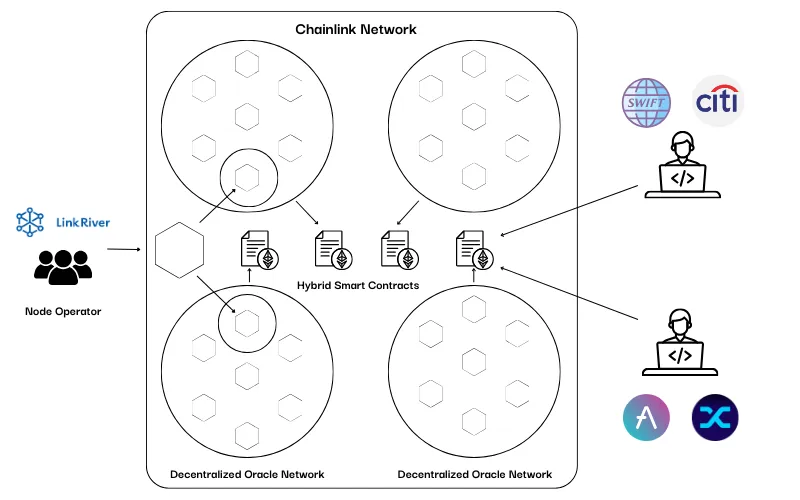
Visualization of the Chainlink Network, its components and participants
How Chainlink Nodes Differ from Other Blockchain Nodes
Proof of Stake (PoS) validator nodes, also known as miners in the context of Proof of Work (PoW), are responsible for the verification of transaction data during block production and coming to consensus on the state of a blockchain.
These nodes generate revenue through incentives which are paid by some combination of block reward subsidies and user transaction fees spent as gas in the network’s native asset (e.g. ETH on the Ethereum blockchain). To ensure the proper operation of a blockchain, there are in fact various and often overlapping categories of network participants who each play a crucial role:
-
Block Producers (BPs): The entities responsible for ordering and packaging transactions into blocks which are subsequently validated by the network. A consensus algorithm is used to determine which BP is responsible for generating the next block, alongside Nakamoto longest chain consensus which defines rules for determining the canonical version of the chain.
-
Full Nodes: The entities involved in verifying each block proposed by BPs. If the block is found to be valid (i.e. protocol rules have been followed), then the block is added to the full node’s personal copy of the ledger and state changes are applied.
-
Archive Nodes: Entities which typically have high hardware requirements and are commonly run by service providers (e.g. block explorers). Archive nodes store previous states of a blockchain and are useful for querying arbitrary historical data.
-
Light Clients: A limited form of a full node in which only the block headers are downloaded to verify whether a transaction was included within a block.
-
RPC Providers: Third-party full nodes which facilitate read/write access to a blockchain through Remote Procedure Call (RPC). Any user connected to an RPC provider does not self-verify and implicitly trusts the provider.
In contrast to blockchain validator nodes, Chainlink nodes get paid for the successful execution of jobs which need to be defined and added to the node in order to participate in a DON. If users want to benefit from the corresponding Chainlink service, they must pay compensation in LINK tokens to the node operators securing such DON.
The user type of Chainlink node services ranges from individual smart contract developers to emerging Web3 unicorns and leading financial institutions. What they all have in common is that they develop dApps that leverage the best features of decentralized and legacy/centralized technologies by enriching their smart contracts with real-world data and off-chain compute.
Since the planning, configuration and maintenance of Chainlink DONs is very complex, a high level of expertise is required to ensure security and cost-effectiveness. Chainlink node operators therefore need to qualify for participation in the DONs coordinated by Chainlink Labs or build their own customer base to generate revenue.
Chainlink Services Secured by Chainlink Nodes
Chainlink node operators power numerous trust-minimised oracle services to help expand smart contract use cases. The following is a list of the currently available services that Chainlink Labs is actively developing:
-
Cross-Chain Communication (CCIP): The global standard for building secure cross-chain applications. Enables the secure connection of hundreds of private and public blockchains, as well as bank chains, forming the backbone for the Internet of Contracts
-
Data Streams: High frequency market data with sub-second delivery for the DeFi derivatives market
-
Market and Data Feeds: Decentralized data feeds that enable the use of price reference data (crypto, forex, stocks), as well as sports, weather and other data on-chain
-
Functions: Allowing developers to integrate any common web API into their smart contracts by interacting with a Chainlink DON handling requests and responses including secure API authentication. This enables limitless customization and the use of any kind of real-world data on any blockchain.
-
Automation: Whilst revolutionary, smart contracts are lacking in certain functions such as timekeeping and self-execution. This service allows for highly reliable decentralized smart contract automation which gives rise to more feature-rich applications at lower cost.
-
Verifiable Random Function (VRF): Generating cryptographically proven random numbers for blockchain gaming and NFT projects
-
Proof of Reserve: A decentralized standard for definitive on-chain and off-chain proof of any asset’s true collateralization. Enabling businesses to get access to automated independent audits of their financial reserves for proving the existence of assets to depositors and other counterparties
Different Types of Chainlink Node Operators
Now that you have learned about the role and importance of Chainlink nodes, we would like to introduce the different types of Chainlink node operators. According to our observation, a division can be made into the following three categories:
Web2-native enterprise: These are typically existing telecommunications firms with decades of experience operating backend infrastructure for the Web2 economy and other innovative IT corporations. Representatives of this category include T-Systems, Swisscom and LexisNexis.
Web3-native enterprise: This group includes specialists in operating Web3 infrastructure, typically across various PoS networks, such as blockchain validators and RPC providers, but also cryptocurrency exchanges.
Well-known examples are Infura, Coinbase and Blockdaemon.
Independent infrastructure specialists: These are operators whose entire business is built around running Chainlink infrastructure to institutional standards, rather than as one activity inside a larger corporation. LinkRiver operates in this category alongside firms such as Fiews, DexTrac, MatrixedLink and NorthWestNodes.
Get More Insights by a Top-Tier Chainlink Node
Now that you have learned the basics about Chainlink nodes and the critical role they play in the blockchain world, it’s time to dive deeper into the Web3 infrastructure business.
To understand in more technical detail what components a Chainlink node consists of, we recommend our article How to set up a Chainlink node.