
AI and Blockchain: Exploring the Synergy
Table of contents (8)
- 1Safeguarding AI with Blockchain Technology
- 2Authenticity Verification and Cryptographic Validation
- 3Verifying Identity
- 3.1Decentralized Finance (DeFi) Empowered by AI
- 3.2Revolutionizing Supply Chain Dynamics
- 3.3Tackling Transparency Challenges in AI
- 3.4Decentralizing Data Storage for Artificial Intelligence
- 4Exploring AI and Web3 Applications
In the dynamic realm of disruptive technology, two impactful entities, blockchain and Artificial Intelligence (AI), have gained prominence, significantly influencing industries in distinct ways. Over the past decade, these transformative technologies have surged, leading experts to delve into the possibilities emerging from their convergence.
Safeguarding AI with Blockchain Technology
Blockchain stands as a formidable guardian for AI systems, leveraging its decentralized structure, cryptographic foundation, and the principles of open source technology. Developers embed specific parameters into the blockchain, creating systems resistant to tampering and adversarial exploits. The decentralized and open source nature of blockchain raises the bar for adversaries attempting to compromise entire systems, enhancing the safety and integrity of AI applications.
While open source code significantly contributes to decentralization, blockchains provide further assurances. Blockchain’s potential for decentralization extends to the creation of Decentralized Autonomous Organizations (DAOs), a concept pivotal in discussions about decentralized AI ownership. In the case of decentralized AI ownership, envision a DAO as a collective entity formed by individuals who hold tokens representing ownership or governance rights within the organization. These tokens provide voting power, allowing participants to have a say in the decision-making processes.
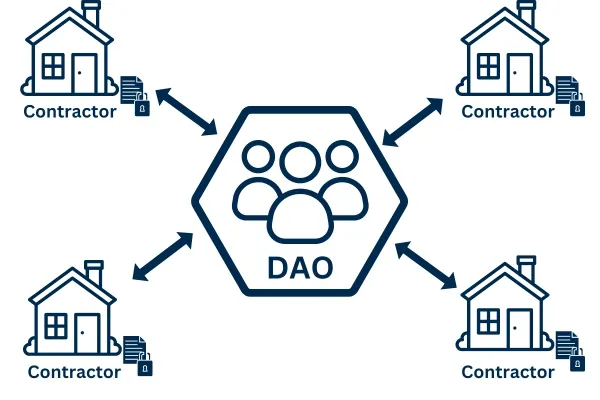
DAO: Blockchain and Artificial Intelligence
DAOs operate based on smart contracts, which are self-executing with the terms of the agreement directly written into code. These contracts facilitate the governance mechanisms of DAOs, ensuring transparency, immutability, and cryptographic truth. Smart contracts on the blockchain automate and enforce the rules established by the DAO, removing the need for intermediaries and reducing the risk of manipulation.
The potential applications of DAOs in the realm of decentralized AI are vast. They can be instrumental in determining how AI models are trained, validating the authenticity of generated content, and even addressing intellectual property concerns. By fostering a community-driven approach, DAOs provide a framework where decisions are collectively made, aligning with the principles of decentralization, transparency, and participatory governance.
However, while DAOs present an exciting avenue for decentralized AI ownership, they also come with challenges. Issues such as governance disputes, security vulnerabilities, and the need for effective mechanisms to prevent malicious actions need to be carefully addressed. As the intersection of blockchain and AI evolves, DAOs represent a pioneering model for reimagining ownership and decision-making in the digital era.
Authenticity Verification and Cryptographic Validation
As advancements in deep learning models, exemplified by technologies like DALL-E, Stable Diffusion, and Midjourney, escalate, so does the concern over the surge in convincing fake content. The rise of accessible tools like GenAI and ChatGPT has democratized the creation of ultra-realistic fake images and videos. This accessibility, coupled with the challenge of distinguishing between real and fake in crucial areas, poses serious challenges to societies.
Addressing this challenge requires a robust mechanism to affirm content authenticity. One solution lies in implementing a public, immutable ledger—a blockchain. Blockchain’s cryptographic validation capabilities can help authenticate the origin of images, videos, and text documents. Techniques such as cryptographic watermarking and timestamping, when applied to decentralized platforms, establish a transparent and tamper-proof record of content. This builds a cryptographically verifiable history, fostering truth in the authenticity of digital media.
Verifying Identity
If you take the example of art, the following possibility arises: once an image is committed to a blockchain, it opens the gateway for the association of that image with the author’s identity. The innovation here lies in the introduction of reputation tokens, a fundamental element of blockchain technology. These tokens allow individuals to financially stake their reputation, providing a tangible measure of their confidence in the authenticity of the content they share. It’s a pledge that puts credibility on the line, adding another layer of verifiability.
This principle isn’t limited to art alone; it extends to any objective fact that can be observed, reported, and stored immutably for public reference. Authenticated data points act as anchors of truth, forming the foundation for assessing the authenticity of diverse content.
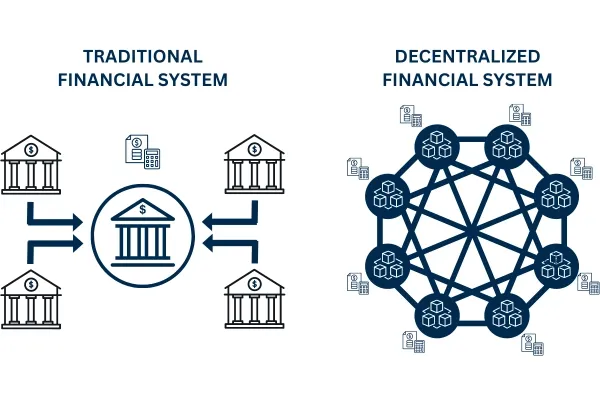
Blockchain and AI: Decentralized Finance
Decentralized Finance (DeFi) Empowered by AI
Decentralized Finance (DeFi) can be empowered by AI models, executing tasks based on predetermined instructions within the Web3 economy. Automated investment strategies, powered by AI and blockchain, introduce transparent and decentralized financial services. This convergence may as well facilitate automated compliance and fraud detection processes, enhancing the overall efficiency and security of financial transactions.
Revolutionizing Supply Chain Dynamics
The integration of AI and blockchain offers a paradigm shift in supply chain management. Smart contracts, executed on a blockchain, enable AI models to automate tasks like inventory management and order execution. This combination enhances transparency, reduces the risk of fraud through digitization, and provides real-time tracking of goods. In disaster relief scenarios, AI-driven analytics coupled with blockchain-based tracking can optimize resource allocation, ensuring timely delivery of essential supplies.
Tackling Transparency Challenges in AI
Another challenge related to AI is the lack of transparency in deep learning models. Blockchain’s transparent record-keeping provides an avenue to mitigate the transparency issues associated with deep learning models. By enabling audit trails of algorithmic decision-making, blockchain fosters accountability and integrity in the realm of AI-generated recommendations. This transparency facilitates the analysis of audit trails, offering insights into the decision-making patterns of algorithms. Moreover, the use of an immutable data ledger reveals the underlying data on which the models rely, contributing significantly to the overall transparency and integrity of AI-generated recommendations.
Decentralizing Data Storage for Artificial Intelligence
The security and privacy vulnerabilities inherent in centralized data storage solutions, which often store sensitive user data, demand innovative alternatives. Blockchain’s decentralized and secure storage solutions present a transformative paradigm for various applications and networks. Utilizing nodes, decentralized storage ensures client-centric encrypted copies of databases, offering both security and data availability.
One pivotal aspect of decentralized storage solutions is the implementation of techniques such as Sharding and Swarming. Sharding involves creating logical partitions known as “Shards,” each assigned a unique key for access. Furthermore, Swarming leverages “Swarms” to enable parallel data access across multiple nodes, enhancing the efficiency and performance of AI applications by reducing latency. The collective storage formed by grouping shards is supported by swarms in the network.
The adoption of decentralized storage not only addresses security concerns but also contributes to enhanced reliability and scalability. Utilizing multiparty geographical distributions, decentralized storage solutions like Storj, Swarm, Sia, FileCoin, and IPFS offer a robust infrastructure for AI systems. The integration of blockchain-based decentralized storage into the deep learning stack actively fosters transparency, reliability, and trust in the decision-making processes of AI systems.
Exploring AI and Web3 Applications
For years, the exploration of dynamic connections between blockchain and AI has sparked curiosity, given their roles as the predominant deep software technology trends of the past decade. While recognizing surface-level synergies – such as Web3 decentralization countering AI centralization and crypto’s transparency balancing AI’s lack of transparency – specific applications were hard to find in historical contexts. However, a transformative shift has become evident in recent years.
With the emergence of more potent AI, particularly in the form of modern Large Language Models (LLM), and the advancements in crypto through blockchain scaling solutions, Zero-Knowledge Proofs (ZKPs), Fully Homomorphic Encryption (FHE), and Multiparty Computations (MPC), the landscape is evolving. Promising applications of AI within blockchain ecosystems or in conjunction with cryptography are becoming apparent. It is crucial, though, to approach the application of AI cautiously, considering the unique challenges that arise.
A significant challenge lies in the balance between cryptographic security and the vulnerability introduced by open-sourcing AI models or their training data. Cryptography dictates that open source is the path to true security, yet in AI, openness increases susceptibility to adversarial machine learning attacks. In the following sections, we’ll classify different ways in which the fusion of blockchain and AI could intersect, exploring the prospects and challenges within each category.
Cryptographic Overhead: The integration of cryptographic gadgets, especially general-purpose ones like ZK-SNARKs and MPC, poses a high overhead challenge. AI computation is already expensive, and the most powerful LLMs come with multimillion-dollar computational costs for training. However, the unique structure of AI models, primarily consisting of matrix multiplications, allows for efficient ZK-SNARKs and MPCs to handle cryptographic tasks with surprisingly low total overhead.
Black-Box Adversarial Machine Learning: Despite ongoing efforts to maintain the privacy of AI models, susceptibility to adversarial examples persists as a notable challenge. These specialized inputs can manipulate machine learning models into producing incorrect outputs, posing a significant threat.
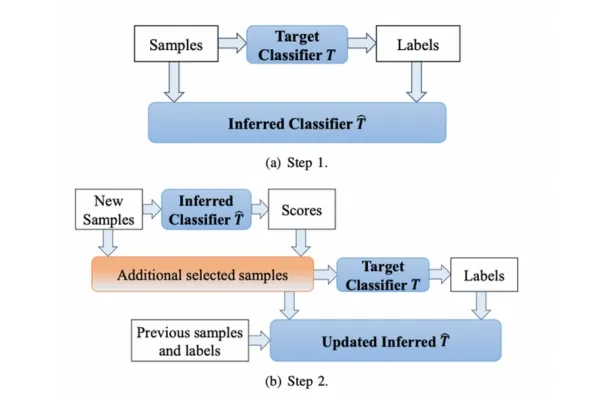
Attackers refine your locally stored “inferred classifier” using black-box access to a “target classifier.” They then create optimized local attacks against the inferred classifier, which usually also succeed against the original target classifier. Diagram Source
To mitigate such black-box attacks effectively, two crucial measures are required:
-
Implement restrictions on entities or processes that can query the model and the extent of such queries, ensuring that black boxes with unrestricted API access are considered insecure, while those with highly restricted API access are deemed more secure.
-
Conceal the training data while maintaining assurance in the integrity of the process employed to create the training data. This involves safeguarding against any corruption in the generation process.
Challenges and Caution: Balancing cryptographic security with the practicality of fully-black-box architecture is challenging. Decentralizing the training data submission process may face obstacles, such as protection against poisoning attacks. Risks include potential breaches in safety or privacy guarantees due to collusion in multi-party computation gadgets.
Improving Existing Centralized Systems: Blockchain technology can enhance centralized systems, such as social media rankings, by introducing techniques like verified AI with delayed publication. Verification processes and community testing can ensure fairness, with publication delays mitigating the risk of outdated models.
AI as the Objective of the Game: Creating scalable decentralized private AI through blockchain and MPC methods could extend utility beyond blockchains. Applications include governance of systemically-important AIs and ensuring AI safety with a decentralized kill switch. Incentivizing better AI through crypto incentives, as seen in approaches like BitTensor, offers potential without full encryption.
The challenges are palpable, from cryptographic overhead to the intricate dance with black-box adversarial machine learning. Nevertheless, as the landscape evolves, the promise of creating scalable decentralized private AI, governance of systemically-important AIs, and the incentivization of better AI through cryptoeconomic mechanisms shine through.
In this ever-evolving realm, the journey continues, marked by innovation, challenges, and the continuous effort to shape a future where blockchain and AI stand as pillars of transformative progress. The possibilities are vast, and as we tread carefully into uncharted territories, the nexus of blockchain and AI promises a future rich with groundbreaking advancements and paradigm-shifting solutions.